Service Territorialization in the Cloud Model
 💬 French version here
Quote: Ophélie Coelho, Figure 8 in "Géopolitique du numérique : l'impérialisme à pas de géants" (Editions de l'Atelier, 2nd ed., 2025), CC BY 4.0. The book is not yet available in English or other languages. If you are a publisher and would like to get in touch regarding a translation, you can contact me here.
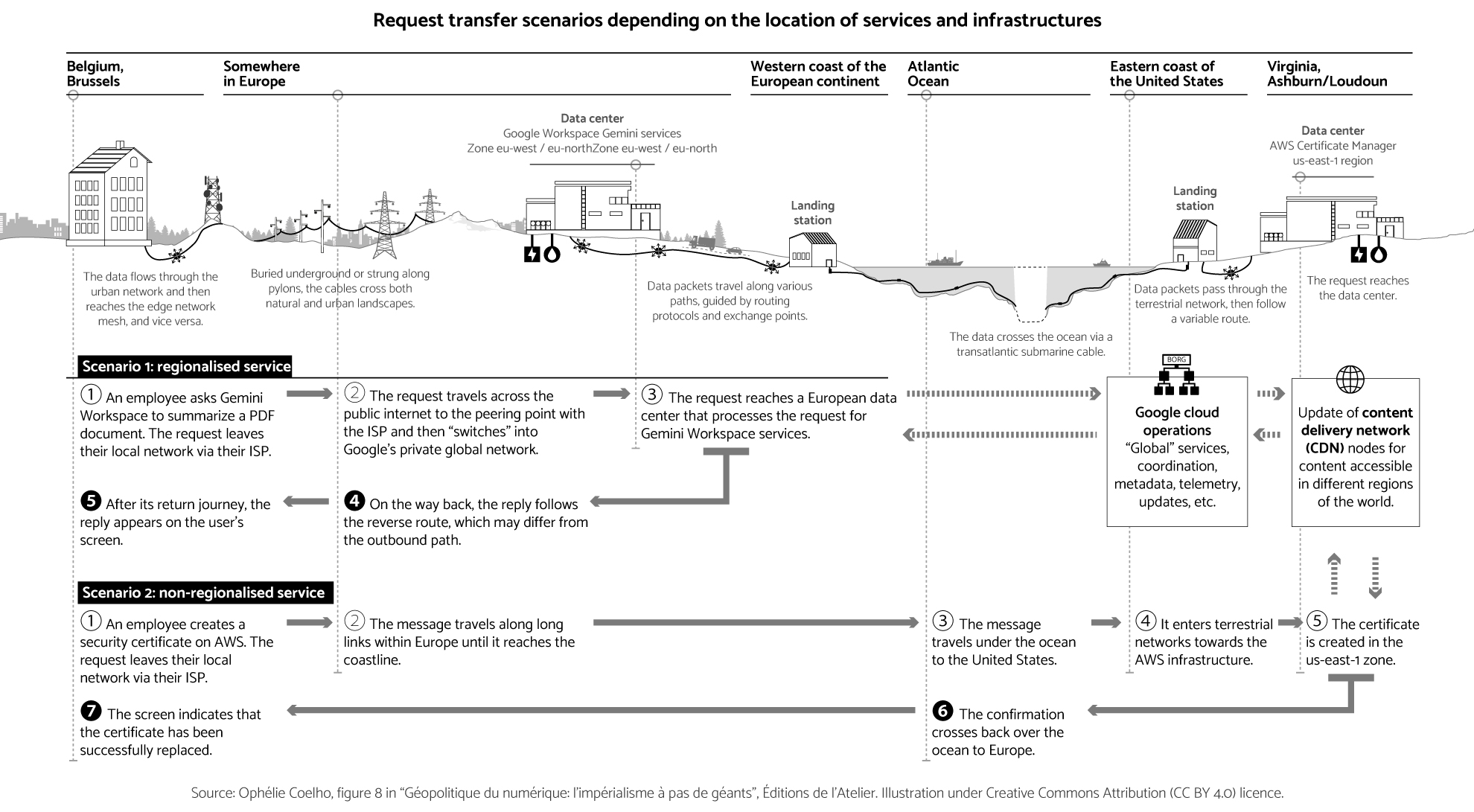
The diagram offers an end-to-end analysis of the path of a digital request, showing that its trajectory depends on the actual geography of the services, networks, and data centers involved, as well as the preferred technological model (in this case, cloud computing).
The illustrated section first outlines the successive technical layers. At the inter-network level, packets follow multiple routes, guided by routing protocols, traffic, and exchange points. When the destination is located on another continent or in an area difficult to access by land, the crossing is most often made via submarine cables, flanked by two landing stations that serve as an interface between the terrestrial and oceanic segments1.
Scenario 1 describes a service offered by a cloud platform that has been regionalized. (1) An employee makes a request—in this case, a summary of a PDF document via Gemini Workspace—and the request leaves the local network through the access provider. (2) It travels across the public internet to the most relevant point of presence, where the service provider is interconnected with the ISP. The request then switches to Google's global private protocol network2. (3) It reaches a European data center that processes the request3. (4) The response returns to the user, following a reverse path that may not be exactly the same as the outbound journey. (5) Upon arrival, the result is displayed on the screen.
Even in this "regionalized" service scenario, the diagram highlights cross-cutting functions that, in all cases, require a connection to the non-territorialized core technology. Cloud operations (coordination, metadata, telemetry, updates, etc.) highlight the existence of an administration and observability plane specific to the core technology, distinct from the data plane strictly necessary for processing the request. The updating of cloud-based delivery networks (CDNs) also illustrates how content and parameters can be replicated, cached, and served from multiple regions to optimize global access, thus complicating any purely territorial interpretation of location.
Scenario 2 presents a service offered by a cloud platform that has not been regionalized. (1) An employee creates a security certificate via AWS. (2) The message travels over long distances within Europe to the coast. (3) It then crosses the ocean via a submarine cable to the United States. (4) It enters the terrestrial networks that lead to the AWS infrastructure. (5) In the example, the certificate is assumed to be created in the us-east-1 zone, in Ashburn4. (6) The confirmation then crosses the Atlantic back to Europe. (7) The user interface then displays the successful completion of the operation.
These two scenarios highlight a reality of the logic behind regionalizing a service, which does not mean that it is detached and independent from the rest of the platform. The regionalized components remain embedded in an integrated platform: they depend on a centralized technological core.
The relationship between the core and peripheral services is expressed in a geography that serves to preserve a technical center of gravity with locally operated peripherals, and a core that retains the capacity to order, measure, authorize, and reconfigure.
Regionalizing computing adds a crucial territorial layer: it does not dissolve the center; it shifts the burden of computing to peripheral areas. Thus, intensive, energy-intensive, and sometimes water-intensive infrastructure projects have repercussions in competing development zones, where land, electrical connections, and networks are mobilized. The territory then becomes a landing place for material costs, while architecture remains extremely hierarchical and structured by the interests and standards of the technological core and economic centers.